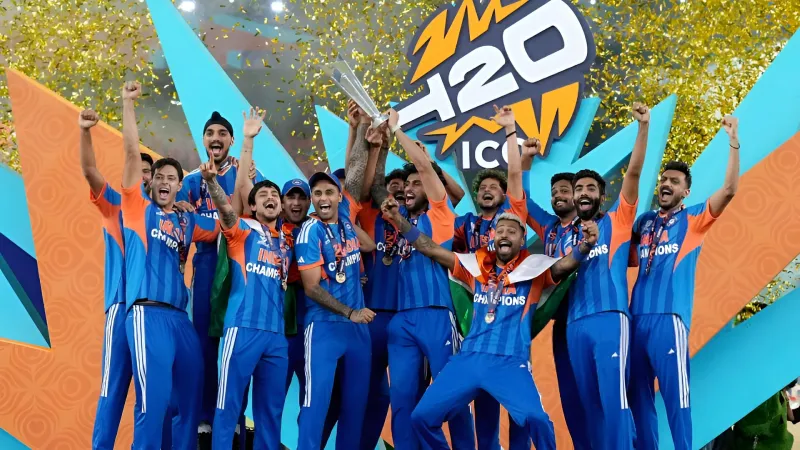
The Blue Wave: Why India’s white-ball dominance will continue. (Photo Source: MB Media/Getty Images)
There is a specific kind of inevitability that settles over a cricket ground when the sense of an Indian victory takes hold. It is not merely the quiet of a losing crowd; it is the collective realisation that the gap between India and the rest of the world has become a chasm.
As I sat in Dublin, watching the blue light of the 2026 T20 World Cup final bounce off my walls, I wasn’t merely watching a good run of form. We are witnessing the era of the Blue Monolith. Yesterday’s 96-run demolition of New Zealand in Ahmedabad was a coronation of a ruler whose reign will rival that of Queen Victoria. By becoming the first nation to successfully defend a T20 World Cup title, India has made the shortest format of the game look sterile and calculated. A strict science.
This dominance is rooted in a financial reality that has moved India beyond the dated Big Three narrative into a league of its own. The BCCI is no longer just a wealthy board; it is an economic outlier. With a projected surplus for 2025-26 of approximately INR 6,728 crore, its revenue is nearly fifty times that of Cricket Australia or the ECB.
But this wealth is not just sitting in a bank. It is being weaponised into a scientific manufacturing process of elite talent. The heart of this operation is the new BCCI Centre of Excellence in Bengaluru, a forty-acre campus that is SpaceX for cricket. Here, high-speed yorkers are engineered in 3D motion capture labs, and batting is treated as a physics problem where players train with weighted bats to perfect high exit velocities.
The result of this infrastructure is a brutal domestic pressure cooker that ensures no transition period for the national side. In a population of 1.4 billion, the filtration rate is extreme; by the time a player reaches the Syed Mushtaq Ali Trophy or the IPL, they have already beaten out thousands of professional-level hopefuls. It creates a survival of the fittest ecosystem where legends, like Virat Kohli, can walk away without the building shaking.
When established stars retire, there is no rebuilding phase, only a fresh wave of suffocating dominance. We saw this in the omission of Shubman Gill from the recent World Cup squad; the national Test and ODI captain was left at home simply because the production line had delivered faster, more aggressive impact options like Abhishek Sharma and the returning Ishan Kishan.
The IPL has evolved from a tournament into a year-round global scouting network and a psychological finishing school. Young prodigies are now being signed for record-breaking sums before they even debut for the national side. At the December 2025 auction, we saw CSK spend a massive ₹14.2 crore each on uncapped talents like Kartik Sharma and Prashant Veer, signalling that the future is already bought and paid for. Veer, a high-impact all-rounder who clocks 140 kph, represents the modern prototype of the Indian cricketer, physically dominant, tactically flexible, and psychologically unshakeable.
Even more staggering is the rise of teenage sensations who seem to have skipped the learning curve entirely. The 14-year-old Vaibhav Suryavanshi, who recently smashed a 14-ball fifty in the DY Patil T20 Cup, and 17-year-old Ayush Mhatre, who captained the India U19s to a sixth world title last month, are dismantling veteran bowling attacks with a fearlessness that has been baked into them by the NCA’s curriculum. Mhatre, already a centurion in first-class cricket, bats with a strike rate near 190, reflecting an ultra-aggressive philosophy that makes the rest of the world look like they are playing a different sport altogether.
While other nations struggle to fund A tours, India sends its second string team on shadow tours across the globe, ensuring that by the time a player debuts, they have already mastered foreign conditions. This is the new reality of the T20 landscape. From the boardroom in Mumbai to the biomechanics labs in Bengaluru, India has stopped merely participating in the T20 conversation and started dictating it.
Given this relentless momentum, India will be overwhelming favourites to atone for their shock World Cup loss in 2023 at the ODI World Cup in Africa next year. With the assembly line operating at peak efficiency and the mental scars of the past replaced by the clinical confidence of a defending double champion, it is hard to see any other team being able to catch them under their current dominance. It is a scary landscape for the rest of the world, but for India, it is all smiles.
Written by Tom McCluskey
 ENG vs IND 2026: Persistent rain forces abandonment of first T20I in Durham
 ‘I wasn’t utilised properly in England’ – Shardul Thakur feels he deserved more opportunities
 Towhid Hridoy to lead Bangladesh against Zimbabwe as Litton Das misses T20I series
 Courtney Walsh joins Zimbabwe coaching staff as permanent bowling coach