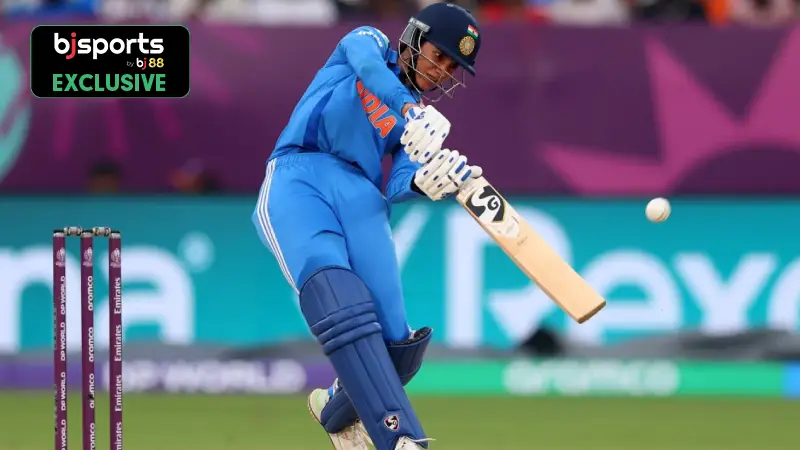
There’s poetry in the way Rohit Sharma and Smriti Mandhana treat Australia. Two different openers from two different worlds, one the experienced ‘Hitman’ of the men’s ODI game, the other the stylish southpaw rewriting the story in women’s cricket, but both are batting engines when the Australians arrive. Mandhana’s 80 in Visakhapatnam was more than just a return to form. It was an attempt at a reminder that the game she plays has the same ice-cold accuracy that Rohit built his empire on. So, who has the better story when the stage reads “India vs Australia”? Let us into the numbers and the nuance.
Two Formats, One Benchmark of Class
Australia has been the supreme test for Indian batters. Rohit Sharma has been dominant, with 2,407 runs at 57.30 in 46 ODIs. But Mandhana has been good too, with 996 runs at 49.80 in 20 games. The difference can be closed if we look for opportunity, for both average around 50+ against the toughest bowling groups in the world. While Rohit’s dominance is a matter of course, Mandhana’s is a matter of defiance: a southpaw’s challenge to the traditional narrative of power. Her innings of 80 in Visakhapatnam did not score India the match, but it did win her something rarer: credence against the big boys.
When Fluency Met Firepower
Mandhana’s 108 strike rate against Australia is not only impressive, but it is also disruptive. Instead of accumulating, she dismantles. Batting against an attack containing Schutt, Perry, and Vlaeminck, the nine fours and three sixes struck by Mandhana in Visakhapatnam proved that her range is not limited to the sub-continent. On the other hand, compare Rohit’s strike rate of 96, and the classical control with which he plays his innings, and the contrast is sharp; it is a fearless acceleration as opposed to classical control. Both, of course, score by timing and not power, but Mandhana’s tempo reflects the current Indian model, the new pattern of cricket that prioritizes the intent: elegant but effective cricket.
Pressure? She Seems to Prefer It
While pursuing target runs, Mandhana has an average of 55.33, which is ahead of Rohit’s 54.53. It is something remarkable for a batsman in a side that is still learning how to chase after somewhat difficult and harassing targets. In fact, Mandhana has made two hundreds in nine innings, which shows a composure that we are not accustomed to seeing a great deal in women’s one-dayers. Rohit, too, has his own way of saying that he is accustomed to chasing, but the way he does it sometimes is different, a measured beginning, a finish in crescendo. But Mandhana plays the game of one, looking at the clock. Both have the same unchanging steel of mind, but they are different in their different gears.
The Numbers Hide a New Narrative
Rohit’s 8 centuries to Mandhana’s 4. This indicates a huge gap, but the context alters all that. Rohit has played 46 ODIs against Australia; Mandhana has not half as many. Of these 50-plus scores, when adjusted to volume more than usual, her conversion rate is 50 percent, the same as the Hitman’s. Mandhana’s average at home is 63.77 in ODI, the highest ever by any Indian woman against any Australian combination in history. It is not all runs, either, but the infrequency of resistance these also. Hence, her elevation shows that the batting levels of India, even in the women’s game, are beginning to come nearer the levels attained by the men for a fair time past.
Mandhana is not “India’s Rohit Sharma in women’s cricket.” She is India’s Mandhana, and that is precisely the point. The statistical similarities are real, but the significance is greater: she is showing that Indian openers can strike fear in Australia in all formats.
Key Takeaway
Smriti Mandhana’s record against Australia mirrors Rohit Sharma’s not by imitation, but by evolution.
FAQ
1. How does Smriti Mandhana’s ODI record against Australia compare to Rohit Sharma’s?
Both average around 50 against Australia, but Rohit has more runs and centuries due to playing over twice as many matches.
2. What makes Mandhana’s recent 80 against Australia significant?
It marked her return to form and made her the first woman to score 1,000 ODI runs in a calendar year.
3. Who has the higher strike rate against Australia — Mandhana or Rohit?
Mandhana with a strike rate of 108.02 compared to Rohit’s 96.01.
Disclaimer: This Exclusive News is based on the author’s understanding, analysis, and instinct. As you review this information, consider the points mentioned and form your own conclusions.
For more exclusive updates, visit BJSports to access Exclusive News that is only for you, incisive analysis, and updates, and to keep up with all of the latest information on your favorite remarkable cricket players and teams. To ensure you never miss out, join in on the fun right away!
 Predicted Playing XI of Sri Lanka in 2nd T20I against England
 Predicted Playing XI of England in 2nd T20I against Sri Lanka
 Top 3 player battles to watch out for in Match 35 of CPL 2026 between Barbados Tridents and Guyana Amazon Warriors
 Top 3 bowlers to watch out for in Match 35 of CPL 2026 between Barbados Tridents and Guyana Amazon Warriors