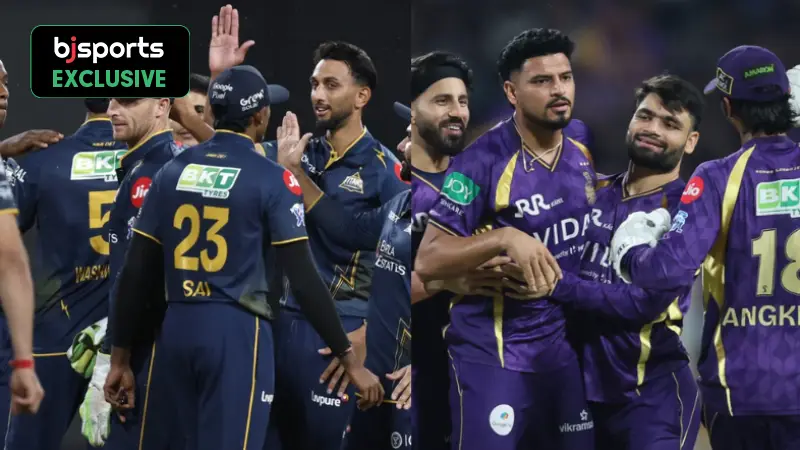
Prasidh Krishna. 10 wickets from four innings. Best of 4 for 28. KKR’s top order targeted before they’ve settled. Rashid Khan. Five wickets from four innings. Best of 3 for 17. Middle-order partnerships broken through dot ball accumulation and variation. Vaibhav Arora. Six wickets from four appearances. New ball swing creating the powerplay pressure KKR need. Three bowlers. Three separate phases. GT’s bowling combination covers two of those phases with their most dangerous available options. KKR’s answer is concentrated in Arora’s powerplay window. That asymmetry shapes the match’s competitive balance before the first ball is bowled.
Prasidh Krishna 10 Wickets Pure Dominance
The specific quality that makes Prasidh Krishna the most structurally disruptive bowling asset in this fixture is the rate at which his wickets arrive, his strike rate confirming that breakthroughs come quickly rather than after extended pressure building. 10 wickets from four innings with a best of 4 for 28 reflects a bowler who changes match situations rather than contributing to sustained bowling pressure.
Against KKR’s batting lineup, capable of aggression in the powerplay but occasionally vulnerable to early wicket-taking before the middle order is set, his hard length generating steep bounce creates the specific physical and cognitive discomfort that forces the false shot. A wicket in the third over changes everything about how KKR’s batting plan unfolds.
Rashid Khan
Controls What Pace Cannot
Rashid Khan’s five wickets from four innings at a best of 3 for 17 understates his match impact through the specific mechanism his bowling produces that wicket tallies don’t capture. His economy rate in the middle overs, the phase where his wrist spin operates against set batters on surfaces where pace bowling becomes containment-oriented, is the metric that most directly reflects his value.
KKR’s middle-order batters who arrive after navigating Krishna’s powerplay pace arrive expecting to accelerate against the middle overs, and Rashid’s variations, pace changes, and trajectory differences remove the specific rhythm their acceleration requires. The wickets his dot ball pressure eventually produces arrive from the rash shot that the accumulated frustration generates, rather than from exceptional individual deliveries.
IPL 2026 Arora Is KKR’s Powerplay Weapon
Vaibhav Arora’s IPL 2026 contribution, six wickets from four appearances against GT’s top order, gives KKR the specific early-innings bowling quality that Prasidh Krishna provides for GT. His seam movement both ways against Gujarat’s top order in the powerplay creates the same wicket-taking opportunity that Krishna creates against KKR, an experienced top order facing swing bowling before they’ve established their timing and rhythm.
His best figures of 2 for 38 suggest support-striker rather than match-defining quality, which means KKR’s bowling plan requires Arora’s powerplay contributions to succeed for the subsequent bowling options to have the best possible match state to work with.
Two-Phase Bowling GT’s Structural Advantage
The specific tactical asymmetry that gives GT a structural advantage in this fixture is the two-phase bowling coverage their combination provides compared to KKR’s one-phase primary threat. GT has Krishna owning the powerplay wicket-taking function and Rashid owning the middle-over pressure function, two separate bowling authorities covering two separate match phases with genuine quality.
KKR has Arora owning the powerplay function with competence. Their middle-over equivalent of Rashid, a bowler who specifically owns that phase through quality rather than availability, is less clearly defined. When the match reaches overs eight to fifteen, GT’s bowling plan has a designated primary option. KKR’s is more improvised.
Krishna Early Rashid Middle GT Wins
The specific match outcome formula that GT’s bowling combination points toward is the sequential phase control model, Krishna taking powerplay wickets that compromise KKR’s middle-order situation, Rashid maintaining pressure through the middle overs against batters who arrived under scoreboard stress rather than from comfortable powerplay platforms. When both functions execute in the same match, the GT bowling unit produces the match-winning performance that their individual quality suggests is available.
The question is whether KKR’s Arora can take enough powerplay wickets against GT’s top order to create the equivalent pressure dynamic from the other direction, disrupting GT’s batting before their own bowling advantage can be deployed.
- Does Prasidh Krishna’s 10-wicket powerplay dominance give GT the early control that Rashid’s middle-over quality converts into a match-winning bowling performance, or does Arora’s swing provide KKR the powerplay breakthroughs that make their bowling combination competitive before GT’s superior two-phase advantage can assert itself? Drop your prediction and follow for IPL updates.
FAQs
Q1: What time does the GT vs KKR start?
The match is scheduled to begin at 8:00 PM IST.
Q2: Where can I watch GT vs KKR live?
The match will be available Live Stream on Sports Live Hub (SLH).
Q3: Who is the key player in GT vs KKR Match 25?
Prasidh Krishna stands out due to his 10 wickets in just 4 innings.
Disclaimer: This Exclusive News is based on the author’s understanding, analysis, and instinct. As you review this information, consider the points mentioned and form your own conclusions.
For more exclusive updates, visit BJSports to access Exclusive News that is only for you, incisive analysis, and updates, and to keep up with all of the latest information on your favorite remarkable cricket playes and teams. To ensure you never miss out, join in on the fun right away!
 Top three performances of Trent Boult in T20s
 OTD 1989: Trent Boult was born
 Top three performances of Trent Boult in Tests
 Top three performances of Trent Boult in ODIs