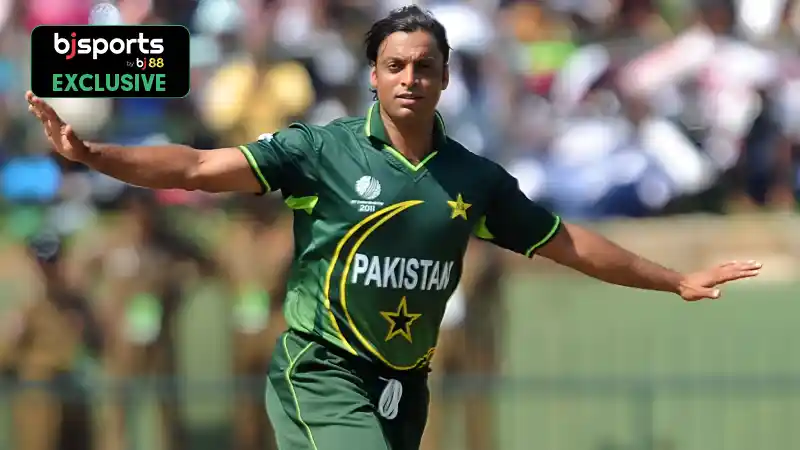
Shoaib Akhtar, one of cricket’s most charismatic personalities, was born on August 13, 1975, in Rawalpindi, Pakistan. Nicknamed the “Rawalpindi Express,” his career was as fierce and unpredictable as the thunderbolts he bowled.
His journey to becoming one of the fastest bowlers in history was anything but ordinary. Leaving college to pursue his dream, he famously travelled on the roof of a bus to attend the PIA team’s Karachi trials, unable to afford the fare. His grit and unconventional approach became a hallmark of his career.
Akhtar’s path to global recognition began in the early 1990s. After making waves in domestic cricket, his raw pace caught the attention of the Pakistan Cricket Board. Selectors could not ignore his ability to consistently bowl over 150 km/h (93 mph). Making his Pakistan debut in 1997, he quickly stood out for his blistering pace and aggressive style, becoming one of the most feared bowlers in the world.
His breakthrough moment came in 1999, when he dismissed Rahul Dravid and Sachin Tendulkar in consecutive deliveries during a packed Test at Eden Gardens, handing Tendulkar his only golden duck in Test cricket. That same year, he played a pivotal role in Pakistan’s run to the World Cup final. In the 2003 World Cup, Akhtar made history by officially breaking the 100 mph barrier with a delivery clocked at 161.3 km/h against England.
Despite his immense talent, Akhtar’s career was often overshadowed by controversies and injuries. He made headlines for run-ins with teammates and coaches, accusations of ball tampering, and even substance abuse charges. Clashes with the Pakistan Cricket Board, including a public spat with captain Waqar Younis, further strained his career.
Even so, his numbers speak volumes as he took 178 wickets in 46 Tests, while he claimed 247 scalps in 163 ODIs. He also played 15 T20Is, taking 19 wickets. He announced his retirement during the 2011 World Cup, co-hosted by India, Sri Lanka, and Bangladesh.
Akhtar’s legacy lies not just in his statistics, but in the fear he instilled in batters. Post-retirement, he has carved out a career in commentary, where his outspoken and bold views keep him firmly in the spotlight.
Disclaimer: This Exclusive News is based on the author’s understanding, analysis, and instinct. As you review this information, consider the points mentioned and form your own conclusions.
 Predicted Playing XI of Sri Lanka in 2nd T20I against England
 Predicted Playing XI of England in 2nd T20I against Sri Lanka
 Top 3 player battles to watch out for in Match 35 of CPL 2026 between Barbados Tridents and Guyana Amazon Warriors
 Top 3 bowlers to watch out for in Match 35 of CPL 2026 between Barbados Tridents and Guyana Amazon Warriors