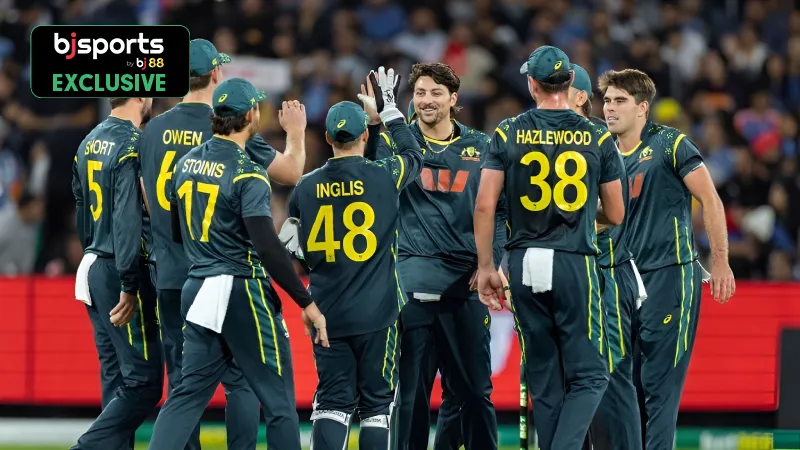
There is an irony developing in Brisbane. As one of the fastest-bowling friendly grounds (The Gabba) in cricket in Australia, they are currently struggling with their “middle order fragility” against India. So far, Australia has only taken 1 win out of three T20Is to date in this series, and with a recent 48-run drubbing still fresh from Carrara, Captain Mitchell Marsh finds himself on a strategic tight-rope.
With a fast and bouncy surface in Woolloongabba that is perfect for using pace artillery to take wickets and for batsmen who have confidence to use the bounce in front of them, historically averages are approximately 175-180 in the first innings; however, with Marcus Stoinis and Glenn Maxwell in the mix, Australia may choose to try to go bigger than these numbers.
Shortcomings at the Top Require Calculated Risks
Matthew Short’s promotion to Marsh as a partner is revealing. Although Matthew Short has shown glimpses of brilliance however he still can’t consistently bat with discipline against disciplined attack bowlers, which India has mastered. Likewise, Marsh can provide both reliability and a medium-pace bowling option, but an excessive reliance on him may lead to potential collapses.
Tim David provides a big-hitting option during the middle overs, but his vulnerability to spin, especially wrist spinners (like Ravi Bishnoi), creates a risk. It appears that the selectors are taking a hybrid approach at the top of the batting lineup that will utilize one explosive innings per match to compensate for less-than-impressive starts.
Spin Strategy Hinges on Zampa’s Reinvention
The leg-spin of Adam Zampa will be a key weapon for Australia, however, the bouncy nature of The Gabba is also a two edged sword for Zampa as it may allow India to play aggressively early through the batting innings when the pitch is at its slowest, while allowing Zampa to take advantage of the deterioration in the pitch to help himself later in the innings.
The use of both off-spin from Glenn Maxwell and leg-spin by Zampa gives Marsh an option to use a tight line with one bowler (Zampa) while using the variation of the other bowler (Maxwell). The use of the same spin bowling combination used during the 2019 Indian tour of Australia was successful in disrupting India’s middle order and therefore suggests that Marsh will rely heavily on the combination to try and disrupt India’s middle order.
Fast Bowlers Must Exploit Pace With Precision
The ability of Ben Dwarshuis, Xavier Bartlett, and Nathan Ellis to create opportunities with The Gabba’s bounce is dependent upon the trio’s ability to remain disciplined. Bartlett’s raw pace and bounce may create uncertainty for opening batsmen, while Dwarshuis provides a different option through his left arm angle. However, if Ellis has a day where he consistently over-extends or delivers a wide ball, it will provide India an opportunity to capitalize on some cheap runs.
Historically, the type of wicket produced at The Gabba rewards batters when bowlers deliver short and bouncy length balls, and previous Australian bowlers who have been successful in previous series have demonstrated they understand how to use these conditions (Johnson and Starc).
All-Round Balance: Maxwell and Stoinis as X-Factors
Maxwell & Stoinis are the two most versatile players in the Australian team; they can both save an innings from falling apart and also take the game away with their bowling skills.
Maxwell’s historical batting average at the Gabba (31.5) & his bowling strike rate (1.2 wickets/match), as well as being able to bowl both orthodox right arm leg spin & right arm off breaks, underlines the potential he has to provide both offensive/defensive contributions on the field; similarly Stoinis is a quality left arm seam bowler who will bring some variation of swing and seam movement into the attack which is going to be a great asset to the attack of Bartlett and Dwarshuis; as such how these two perform may have a lot to say about what the Aussie’s do as a unit.
Key Takeaway:
Australia’s final XI is less about names and more about exploiting The Gabba’s bounce and mastering all-round balance.
FAQs
1: What makes The Gabba unique for T20 cricket?
It’s fast, bouncy pitch rewards pace, bounce, and smart all-around strategies.
2: Why is spin deployment critical against India?
India’s middle order thrives on pace; timely spin can break partnerships and shift momentum.
3: How crucial is the middle order for Australia’s win?
Extremely; without timely contributions from Short, David, or Maxwell, Australia risks early collapses.
Disclaimer: This Exclusive News is based on the author’s understanding, analysis, and instinct. As you review this information, consider the points mentioned and form your own conclusions.
 Top 3 Bowlers to Watch Out for in Test Series Between Bangladesh and the West Indies
 Predicted Playing XI of Bangladesh for First Test Against West Indies
 Predicted Playing XI of Sri Lanka in 5th Match of Tri-Series Against Pakistan
 Predicted Playing XI of Pakistan in 5th Match of Tri-Series Against Sri Lanka