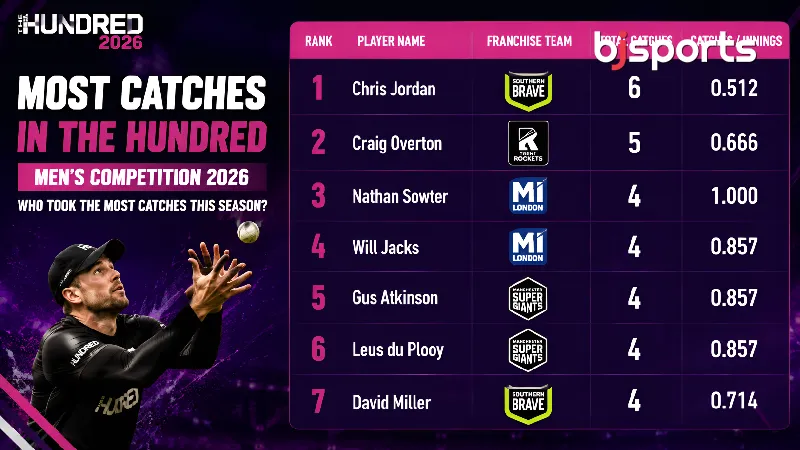
I was three rows back at Lord’s when Chris Jordan dropped low and came up with the ball still in his fingers, and the whole stand rose before the umpire even signalled out. That grab set the tone for a tournament where boundary-line reflexes decided as many matches as big hitting did. Tracking the numbers with BJ Sports afterward, I kept coming back to the same question: which fielders actually shaped this year’s Hundred, and why did their hands matter more than anyone’s bat?
The Night Fielding Stole the Show at Lord’s
The Hundred’s 100-ball format leaves almost no room to hide. Every misjudged step at the boundary or spilled half-chance changes a chase in seconds, and this season that pressure showed up most clearly on the firm, fast surface at Lord’s. Batters attacking early found themselves mistiming shots into the deep more often than usual, and it was the fielders positioned on those boundary ropes who turned those mistakes into finished contests rather than close ones.
What struck me watching from the stands was how deliberate the placement felt. Captains weren’t just filling gaps; they were stationing their sharpest athletes exactly where the data said batters would go under pressure. By the time the tournament reached its final rounds, catching had stopped being a bonus skill and started looking like the difference between lifting the trophy and going home early.
Also Read: CPL 2026 Point Table: Who’s Really Winning the Race to the Playoffs?
Most Catches in The Hundred Men’s Competition 2026
According to data tracked by BJ Sports across the full group stage and knockouts, seven fielders stood out from the rest of the pack on raw numbers and consistency. The table below lines up total catches against each player’s catches-per-innings ratio, since raw volume alone can flatter a fielder who simply played more matches.
| Player Name | Franchise Team | Total Catches | Catches / Innings |
| Chris Jordan | Southern Brave | 6 | 0.512 |
| Craig Overton | Trent Rockets | 5 | 0.666 |
| Nathan Sowter | MI London | 4 | 1.000 |
| Will Jacks | MI London | 4 | 0.857 |
| Gus Atkinson | Manchester Super Giants | 4 | 0.857 |
| Leus du Plooy | Manchester Super Giants | 4 | 0.857 |
| David Miller | Southern Brave | 4 | 0.714 |
Volume and efficiency told two different stories this year. Chris Jordan led every fielder in the competition on sheer catches taken, while Nathan Sowter’s perfect 1.000 ratio meant he simply never dropped a chance that came his way. Both numbers matter, and reading them side by side explains why Southern Brave and MI London leaned so heavily on their fielding units in tight finishes.
Chris Jordan’s Steady Hands for the Southern Brave
Jordan finished the tournament with six catches, more than any other player, almost all of them taken in the high-traffic zones just inside the boundary rope. His anticipation let him close down mistimed pulls and lofted drives before they carried, and Southern Brave built their entire fielding plan around trusting him with the toughest chances. If you want to catch these moments live as they happen, the Southern Brave match is free to stream live online on Sports Live Hub.
David Miller backed him up from the other side of the field, finishing with four catches of his own and a 0.714 ratio that kept Southern Brave’s fielding unit near the top of the standings all season. Together they gave the team a boundary-line partnership that opposition batters had to account for on every big shot.
The Perfect Record: Sowter and Jacks at MI London
Nathan Sowter’s numbers stand out for a different reason. Four catches from four genuine chances give him a flawless 1.000 catches-per-innings ratio, meaning he simply didn’t put anything down all tournament. BJ Sports analysts have found that this kind of consistency usually separates specialist fielders from bowlers who catch well only occasionally, and Sowter’s record puts him firmly in the first group.
Will Jacks matched him on total catches with four of his own, highlighted by a three-catch afternoon on August 2 against Manchester Super Giants that included a spectacular grab on the Lord’s boundary. His 0.857 ratio and his reaction speed under pressure made him one of the most reliable hands MI London fielded all season.
Why Fielding Won Manchester Super Giants the Title
Manchester Super Giants didn’t have the single standout name in the catching charts, but they had the deepest group. Gus Atkinson and Leus du Plooy both finished with four catches apiece and matching 0.857 ratios, giving the champions two reliable options wherever the ball went. The performance metrics on BJ Sports show that squads with multiple fielders above an 0.80 ratio consistently held opponents to lower totals across the tournament.
That depth mattered most in the closing stages, when tired legs and pressure situations expose teams that rely on one or two specialists. Manchester Super Giants never had that problem, and their bowlers could set attacking fields in the death overs knowing the catches would mostly stick.
What Fans Should Watch For Next Season
Fielding coaches across the competition will be studying this data closely before the next edition. Recruiting a batter who can also hold his catches in the deep is becoming as valuable as finding an extra six-hitter, and franchises that ignored that lesson this year paid for it in tight finishes.
The full picture of Most Catches in The Hundred Men’s Competition 2026 makes one pattern hard to miss. Every team that went deep into the knockouts had at least one fielder inside the top seven, and that is not a coincidence anyone should expect to change soon.
The bottom line from this Hundred season: Southern Brave’s boundary reflexes and Manchester Super Giants’ fielding depth proved that catches decide finals, and BJ Sports will keep tracking every grab as next season takes shape. Follow us for more Hundred 2026 stats and fielding breakdowns all season long.
Frequently Asked Questions (FAQs)
Who took the most catches in The Hundred Men’s Competition 2026?
Chris Jordan finished as the tournament’s leading catcher for Southern Brave. He closed the season with six catches, the highest total of any player this year.
Which player had the best catches-per-innings ratio in The Hundred 2026?
Nathan Sowter posted the tournament’s best catches-per-innings ratio at a flawless 1.000. The MI London fielder converted all four chances without a single drop.
How many catches did Will Jacks take for MI London in The Hundred 2026?
Will Jacks finished with four catches for MI London, matching three other fielders. His best game came on August 2, with three catches against Manchester Super Giants.
Which team had the deepest fielding unit in The Hundred 2026?
Manchester Super Giants fielded the deepest catching pair among the top sides. Gus Atkinson and Leus du Plooy each held four catches at a 0.857 ratio.
Did Craig Overton have a standout catching performance in The Hundred 2026?
Craig Overton delivered the tournament’s best single-match haul with three catches in one innings. He reached that mark on July 29, finishing with five catches overall.
Disclaimer:This Today’s Trending (Blog) expresses the author’s personal insights and analysis. We encourage readers to consider the points discussed and draw their own conclusions.
Dive into Sports World like never before! Visit Bjsports for the Today’s Trending (Blog) made just for you—relive golden nostalgia, feel the thrill of today’s updates, and stay ahead of the Sports World. Don’t miss a moment—join the fun now
 Most Catches in Asian Games Cricket 2026: Top Catchers and Best Fielders Ranked
 Most Sixes in Asian Games Cricket 2026: Top 5 Six Hitters Who Ruled the Tournament
 Highest Wicket Taker in Asian Games Cricket 2026: Top 5 Bowlers After the Final
 Most Runs in Asian Games Cricket 2026: Top 5 Batters Who Led the Run Charts