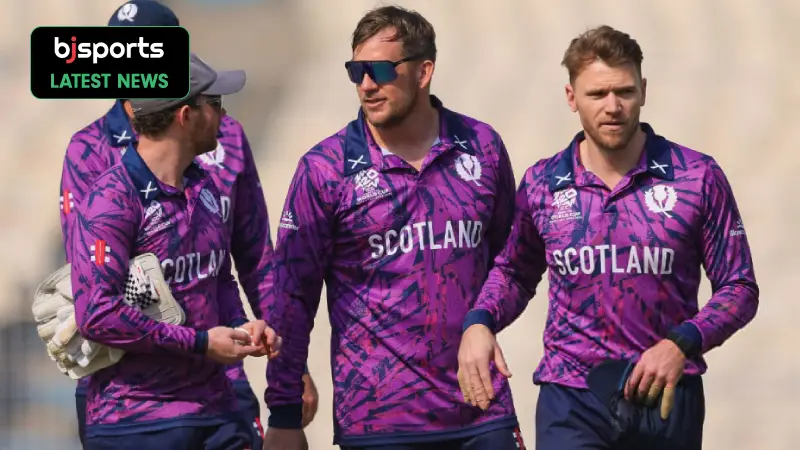
The Cricket boards of Scotland and the Netherlands have issued a joint statement criticising the International Cricket Council’s decision to revise the format for the 2027 ODI World Cup.
The revised structure will see the main tournament reduced to 12 teams in two groups of six, rather than the originally planned 14. The three lowest-ranked qualifiers will compete in a preliminary three-team Super Series, with only the winner progressing to the main group stage.
This meant Scotland and the Netherlands must navigate three separate qualifying tournaments to reach the main stage.
“The changes risk weakening the integrity and credibility of international cricket, and only highlight the importance of strong governance, transparent decision-making and effective engagement with members,” the joint statement from Cricket Scotland and the Royal Dutch Association (KNCB) said.
Boards criticise governance and decision-making process
“Cricket Scotland, KNCB and other Associate members met twice with the ICC, seeking official written communication on the changes and greater clarity around the processes involved,” The statement further read.
“We also requested positive action to strengthen future operational decision-making and an invitation to bilateral planning meetings with full members. Since the second meeting more than two weeks ago, there has been no further response from the ICC, which is disappointing and disrespectful given the significance of the issues raised,” they continued.
A joint statement from Cricket Scotland and the Royal Dutch Cricket Association (KNCB).
➡️ https://t.co/LXig37xx2m pic.twitter.com/cuSIW5VVO6
— Cricket Scotland (@CricketScotland) August 10, 2026
Despite being part of the conference, most Associate Members were reportedly kept in the dark over the change, according to reports at the time.
Players and captains voice concerns over consultation
Players from affected nations have also voiced their concerns about the decision. Scotland captain Richie Berrington urged better consultation with players on decisions affecting their careers.
“Players don’t expect to make every decision, but we should be meaningfully consulted on decisions that have significant impacts on the game and on players’ careers,” Berrington stated.
Netherlands captain Scott Edwards described the decision as “incredibly disappointing” and highlighted the impact on Associate nations’ development.
“The ICC talks a lot about growing the game globally, but decisions like this make it harder for Associate nations to play against the best teams in the world. Those opportunities are what help countries improve and inspire the next generation of players,” said Edwards.
Namibia captain Gerhard Erasmus also expressed concern about the qualification structure.
“For players in many countries, an ODI World Cup isn’t just another tournament. It’s our long-form game and something careers are built around and generations of players aspire to. We all accept that you have to earn the right to be there, but we also want qualification to provide a real opportunity to compete on the biggest stage,” Erasmus noted.
The World Cricketers’ Association has also criticised the ICC for failing to consult stakeholders despite the significant impact on qualification pathways. The association stated that the format change “fundamentally changes” the opportunity originally presented to emerging teams. The 2027 ODI World Cup will be hosted by South Africa, Zimbabwe and Namibia.
Disclaimer: This latest news is based on the author’s understanding, analysis, and instinct. As you review this information, consider the points mentioned and form your own conclusions.
To catch up on the most current news on all of your favorite thrilling cricket upates, visit BJSports to access our comprehensive Latest News, insightful analysis, and updates. connect with the action now to make sure you never miss out!
 ‘There is no bowling as such’ – Hanuma Vihari raises concern over India’s T20I bowling ahead of West Indies series
 ‘Gave Indian cricket everything’ – Yuvraj Singh, Shikhar Dhawan pay tribute to Harmanpreet Kaur after captaincy exit
 ICC postpones World Club Championship plans as England, Australia and India object
 Cameron Green ruled out of first Test vs South Africa with abdominal strain