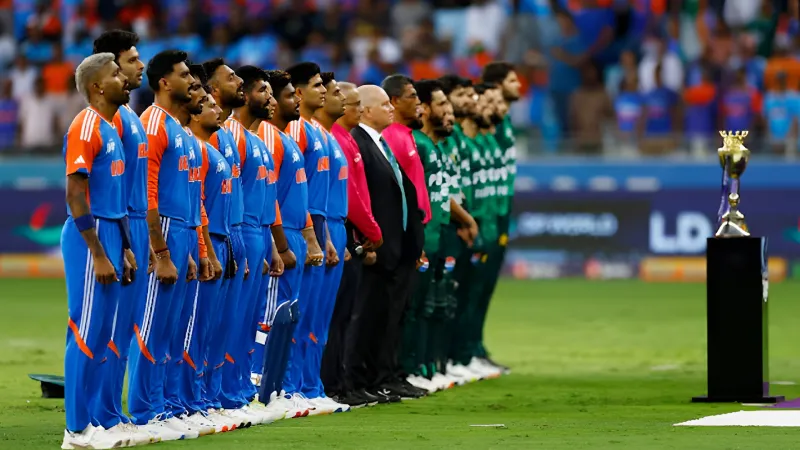
Former ICC chairman breaks silence on India-Pakistan boycott row. (Photo Source: Asian Cricket Council)
The controversy around Pakistan’s decision to boycott its T20 World Cup match against India has increased, with former International Cricket Council chairman Ehsan Mani weighing in on the debate. Ahead of the February 15 clash in Colombo, Mani has stated that the ICC cannot impose sanctions on Pakistan, calling out what he described as double standards in the global game’s governance.
The issue triggered on February 1, when the Government of Pakistan announced that while it had permitted the national team to participate in the T20 World Cup, it would not take the field against India. The decision, framed as a government directive, placed the Pakistan Cricket Board in direct conflict with ICC playing conditions, which mandate full participation once a team qualifies for an event.
Reacting to the ICC’s warning of severe consequences for selective participation, Mani revealed that the governing body lacks the authority to punish Pakistan in this case. According to the former ICC and PCB chairman, the decision has been dictated by the government, putting it over the ICC’s disciplinary reach. He pointed to India’s refusal to travel to Pakistan for the 2025 Champions Trophy as an example.
“There can’t be any sanctions against Pakistan if it follows the government’s instructions. That was the basis on which India refused to play its 2025 Champions Trophy matches in Pakistan. You can’t have double standards. So, unfortunately, again I come back to the fact that instead of dealing with the problem, the ICC just stood there as a bystander,” Mani was quoted as saying by Sportstar.
You left the door open for any country to get its government involved: Ehsan Mani
Mani also criticised the ICC’s handling of the situation, accusing it of failing to address the problem of government interference in cricket. He warned that such episodes open the door for political involvement in sporting decisions, especially when board officials also hold government positions. With PCB chairman Mohsin Naqvi being a serving minister, Mani suggested that the line between cricket administration and state policy has become increasingly blurred.
“You left the door open for any country to get its government involved. And especially knowing that the chairman of the PCB is a serving minister of the government,” he added.
However, the ICC has taken a stance against Pakistan’s position. While confirming that it has yet to receive official communication from the PCB, the governing body stated that selective participation undermines the integrity of global tournaments. In its statement, the ICC urged Pakistan to reconsider, warning that the move could have long-term consequences not just for the PCB, but for global cricket as a whole.
Meanwhile, the India-Pakistan fixture is the most lucrative match in any ICC tournament, drawing massive global viewership and sponsorship interest. A walkover would hand India full points but could reportedly cost broadcasters hundreds of crores in advertising revenue, while also disappointing fans worldwide.
On the other hand, Pakistan has proceeded with its campaign in Group A and will play its remaining matches in Colombo, beginning against the Netherlands on February 7.
 The spin department is where India will be looking to tick a few boxes: Sunil Gavaskar
 ENG vs NZ 2026: ‘Thankful to have a proper debut’ – Sonny Baker opens up on eventful Test debut
 ‘Selection committee deserves compliments’ – Sunil Gavaskar applauds selectors for backing Gurnoor Brar following success in India vs Afghanistan
 Will IPL have 94 games from 2027 season? BCCI President gives official response