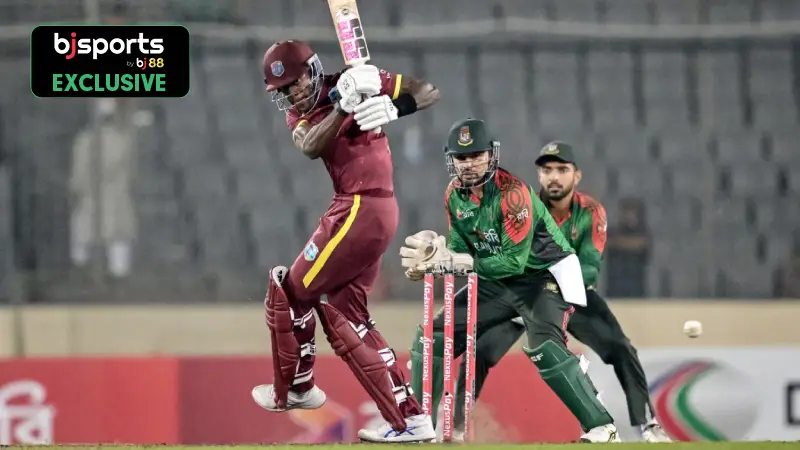
The third ODI of the 2025 West Indies Tour to Bangladesh was ignited by Bangladesh’s performance in Mirpur that ultimately saw West Indies’ run chase go into flames. The evening of the game, the wicket had some help from spin, with uneven bounce to be found in parts of the wicket, and an all-round total of 296 for eight was made by Bangladesh, with Soumya Sarkar and Saif Hassan leading the charge in what could only be described as an authoritative manner. When the West Indies took on the challenge of making nearly 300 to win, confidence was high; however, before the 30th over was complete, the team was bowled out for 117 – a massive 179 short of the target. So what happened to create such a dramatic collapse in performance by the West Indies? We will take a closer look.
Batting Collapse Under Pressure
West Indies’ batting never really regained footing with the early dismissal of Athanaze and Auguste; Nasum Ahmed’s precision through the length and his ability to swing the ball caused great difficulty for the top order as they struggled to counter disciplined line and length bowling. Next, Alick Athanaze was dismissed for 15, then Auguste for zero, and lastly Brandon King could only manage an eighteen; when Shai Hope stepped up to try to stabilize the innings, it was already too late – the team had fallen to 46/4 in just over thirteen overs. The inability of the lineup to develop partnerships under pressure is reflective of the West Indies’ past performances, where they were unable to chase large totals on previous tours in the subcontinent.
Bangladesh’s Game-Changing Bowling Performance
Bangladesh’s bowlers were responsible for orchestrating the collapse of the West Indies’ batting line-up. Nasum Ahmed began to dismantle the West Indies batting with his opening spell (3/11 in 6 overs) by sending back the first three batsmen and ending any potential momentum for the West Indies batting unit. Tanvir Islam and Mehidy Hasan Miraz followed up with key wickets at critical times, and Rishad Hossain took another 3 wickets over 9 overs to ensure that the West Indies were unable to get into a flow of play. The Bangladeshi bowlers utilized an array of subtle seam movement, excellent variations, and consistent line to stump the West Indies batsmen, as they continued to chase shadows instead of the scoreboard.
Overreliance on Key Players and Poor Adaptation
The individual brilliance of Bangladesh aside, it quickly became apparent how much the West Indies relied on a small number of elite players. While batsmen like Shai Hope, Roston Chase, and Justin Greaves were being called upon to provide either stability at the crease or be aggressive to try and stem the tide in terms of scoring against Bangladesh’s bowling attack, neither batsman could withstand the pressure for an extended period of time. Furthermore, the failure of the West Indian team to adapt to a pitch with significant turn made things even more difficult; numerous attempts to play paddle sweeps and lofted drives resulted in bowled LBW wickets and easy catches for Bangladesh.
FAQs
1: Why did the West Indies lose by such a huge margin?
A combination of top-order collapse, Bangladesh’s incisive bowling, and failure to adapt to spin and pitch conditions caused the 179-run defeat.
2: Who was the standout performer for Bangladesh?
Soumya Sarkar, scoring 91 off 86 balls, and the bowlers Nasum Ahmed and Rishad Hossain led Bangladesh’s clinical performance.
3: What went wrong in the West Indies’ batting approach?
The team relied too heavily on key players, failed to build partnerships, and struggled against disciplined spin and seam bowling on a turning track.
Disclaimer: This Exclusive News is based on the author’s understanding, analysis, and instinct. As you review this information, consider the points mentioned and form your own conclusions.
 Predicted Playing XI of Sri Lanka in 2nd T20I against England
 Predicted Playing XI of England in 2nd T20I against Sri Lanka
 Top 3 player battles to watch out for in Match 35 of CPL 2026 between Barbados Tridents and Guyana Amazon Warriors
 Top 3 bowlers to watch out for in Match 35 of CPL 2026 between Barbados Tridents and Guyana Amazon Warriors