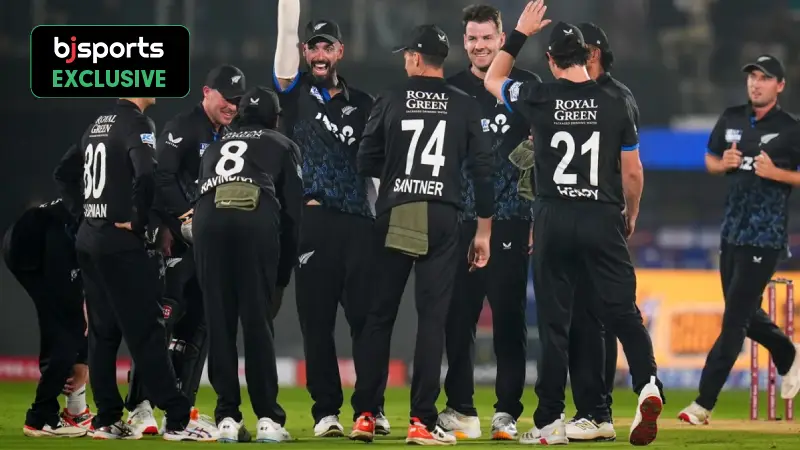
New Zealand is expected to field a balanced, spin-heavy yet flexible unit against the UAE at Chepauk, with New Zealand’s XI vs UAE likely built around all-round depth and matchup control rather than raw pace. Tim Seifert and Finn Allen should open to maximise powerplay intent, while Mitchell Santner’s leadership anchors a bowling attack tailored for Chennai’s slow-but-flattened surface. The presence of multiple spin-bowling all-rounders signals tactical adaptability. Selection matters here because Chepauk rewards teams that can adjust pace, rotate bowlers smartly, and still score at par-plus rates despite grip and turn.
Here are the New Zealand Playing XI vs UAE in the NZ vs UAE T20 World Cup 2026 Match 11:
Powerplay Intent at the Top
The predicted playing XI relies on Seifert and Allen at the top of the order. With Seifert’s ability to keep wicket, this will give them the option to play in different combinations. Allen is an attacking player who is expected to create early disruption, then allow the pitch to slow down and take his time once it does so. With the UAE bowling unit most likely to be using control and not pace to get the best results from their bowlers, the New Zealand batting order has been designed to have the risk up front, which will provide the middle order batsmen to bat with clarity, and not under pressure.
Middle-Order Control and Stability
The probable XI shows that New Zealand has a batting line-up that is designed for the middle overs, as they have selected several batsmen who can perform multiple functions. Glenn Phillips and Mark Chapman are two of these batsmen, and each brings different types of tempo into the game, in terms of how quickly they score runs, and this will be important when making runs more difficult to score after the power play. This middle order is not made up of players who look to hit big shots to get out quickly; they need to keep scoring runs and avoid losing wickets, especially when the ball starts gripping.
All-Rounders as Tactical Currency
The trio of Rachin Ravindra, Daryl Mitchell, Mitchell Santner, and James Neesham is likely the squad prediction for New Zealand. This provides them with the option to vary their bowling based on how they want to match up, rather than being limited to specific bowling duties; the three slow left arm options provide that variation in type, while the four (including Daryl Mitchell and Rachin Ravindra) give them the depth they need in terms of type of bowling. The value that Santner brings as an alternative to the other captains is that he can utilise his ability to slow down the pace of play, double down on using spinners, or even utilise James Neesham’s unique style of disruption by playing him out of position. As such, the strength of this “all-rounder” core is what will be New Zealand’s greatest strength in slow batting conditions.
Pace Attack With Defined Roles
The bowling attack has Matt Henry, Lockie Ferguson, and Jacob Duffy, with three different roles; Matt Henry to provide control at the start of the match, Lockie Ferguson to deliver quality, fast bowling in the middle overs, and Jacob Duffy to be a change-up option when he is required; rather than relying on pure speed, they will look to create confusion and timing based on the surface in Chennai match preview.
Pitch-Fit Over Star Power
Chepauk’s redesigned playing area might be flat, but it is no less demanding of discipline and control of the turn for the batsmen. The New Zealand selectors have reflected this reality by selecting multiple slow left-arm bowlers to bowl into the longer boundaries, and thus to require the UAE to play against the turn. A pitch-fit selection, like many other selections made by New Zealand recently, suggests they are prioritising suitability over sentiment.
The NZ XI vs UAE does not appear to be flashy; however, the XI is very smartly developed to play in Chennai rather than to get attention. It is the smarter teams that can quietly improve at a time when no one is paying much attention.
Key Takeaways
New Zealand’s XI is designed to outthink conditions, not overpower them.
FAQ
Q1: What role does the Chepauk pitch play in NZ’s selection?
It encourages spin-heavy and all-rounder-based selections over pure pace.
Q2: Who is the key all-rounder in this match for New Zealand?
Mitchell Santner, due to his dual role as captain and primary spin option.
Q3: How important is the toss at Chennai in this match?
Moderately important, as batting first allows teams to avoid chasing on a slowing surface.
Disclaimer: This Exclusive News is based on the author’s understanding, analysis, and instinct. As you review this information, consider the points mentioned and form your own conclusions.
 Which Bowlers Will Control the Middle Overs in Limpopo vs Border CSA T20 Challenge 2026?
 Which Player Duel Could Decide Limpopo vs Border, Match 40 of the CSA T20 Challenge 2026?
 Which Side’s Key Players Hold the Edge in SWD vs Warriors, Match 39 of the CSA T20 Challenge 2026?
 3 West Indies Batters Who Could Be a Threat to India in 4th T20I