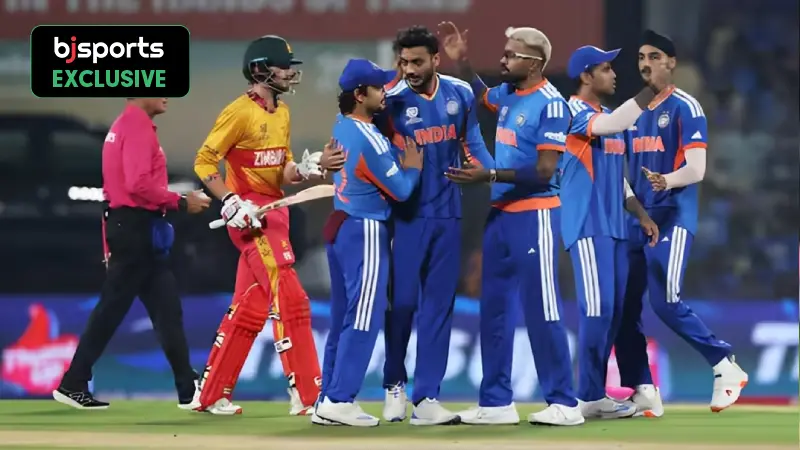
Zimbabwe lost because they allowed India to post 256/4 and never matched the required scoring rate in a 257-run chase, eventually finishing at 184/6 and losing by 72 runs in Chennai. For those searching for why ZIM lost to IND, the scoreboard makes the gap obvious: India scored at 12.80 per over, while Zimbabwe managed just 9.20. Despite Brian Bennett’s fighting 97*, the difference in death-over hitting and bowling control defined this contest. This ZIM vs IND match analysis confirms that the decisive phase came in the final five overs of India’s innings.
Also read: India vs Zimbabwe Predicted Playing XI for their Super 8 Clash
India’s Death-Overs Acceleration Broke the Game
Zimbabwe were competitive for 15 overs, but the final stretch of India’s innings turned the match into a near-impossible chase. At 172/4 in 14.5 overs, India were well placed but not yet out of sight. What followed was decisive.
Hardik Pandya smashed 50* off 23 balls, while Tilak Varma hammered 44* off just 16 deliveries. That late surge pushed India to 256/4, adding 84 runs in the last five overs. In high-scoring tournaments, conceding 250+ almost always shifts win probability heavily.
The bowling figures underline the issue. Richard Ngarava conceded 62 in 4 overs, Tinotenda Maposa went for 40 in just 2 overs, and Brad Evans leaked 52 in his 4-over spell. Only Sikandar Raza (3-0-29-1) provided control. These numbers form the core ZIM defeat reasons, the inability to contain India at the death cost them the match before they even began chasing.
Arshdeep Singh’s Middle-Over Control Ended the Chase
Zimbabwe needed a flying start and sustained partnerships. Instead, they kept losing wickets at critical junctures in the 48th Match T20WC 2026.
Brian Bennett’s 97* off 59 balls was outstanding, but the support around him faded. After reaching 144/3 in 16.2 overs, Zimbabwe still required 113 runs from 22 balls — a mathematical mountain.
Arshdeep Singh delivered the defining spell of the night: 4-0-24-3 at an economy of 6.00. He dismissed Sikandar Raza, Ryan Burl, and Tony Munyonga in a tight middle-to-death phase, halting any momentum. In the ZIM vs IND highlights, this spell stands out as the moment the chase was completely derailed.
48th Match T20WC 2026: Tempo Mismatch and Dot-Ball Pressure
Chasing 257 demands proactive intent from ball one. Zimbabwe never truly imposed itself. At 72/2 in 9.3 overs, they were already behind the rate. Tadiwanashe Marumani scored 20 off 20 balls, and Dion Myers managed 6 off 9 in both innings, increasing dot-ball pressure during a chase that required over 12 per over from the outset.
Unlike India, whose top six all struck above 150 (except Samson), Zimbabwe lacked collective acceleration. Only Bennett and Raza crossed 30. The required rate consistently hovered above 13 after the halfway stage.
Zimbabwe’s defeat can be traced to three connected failures: conceding heavily at the death, losing middle-order wickets under pressure, and failing to sustain scoring tempo during the chase. India’s 256/4 created scoreboard dominance, and despite Bennett’s heroic 97*, Zimbabwe never seriously threatened the target.
FAQs
Who won the 48th match between India and Zimbabwe?
India won by 72 runs after scoring 256/4 and restricting Zimbabwe to 184/6.
Who was the top scorer in the match?
Brian Bennett scored 97* for Zimbabwe, while Hardik Pandya made 50* for India.
Where was the match played?
The match took place in Chennai during the Super Eights stage of the ICC Men’s T20 World Cup 2026.
Disclaimer: This Exclusive News is based on the author’s understanding, analysis, and instinct. As you review this information, consider the points mentioned and form your own conclusions.
 Which Player Duels Will Decide North West vs Limpopo T20 Challenge 2026 Match 45?
 Who Are the Batters to Watch in Northern Cape vs SWD T20 Challenge 2026 Match 46?
 Top 3 wicket-takers from West Indies tour of India 2026
 Top 3 bowlers to watch out for in Match 2 of Tri-Series between Zimbabwe and Afghanistan