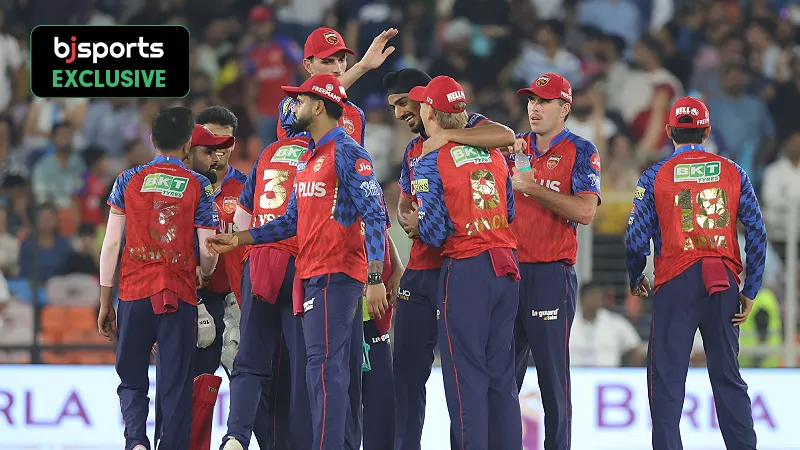
Punjab Kings arrive at Match 55 with a playing XI built around one clear principle: every phase needs a specific answer. Prabhsimran Singh and Priyansh Arya attack the powerplay before Shreyas Iyer steadies the platform. Marcus Stoinis and Marco Jansen cover both batting and bowling phases simultaneously. Arshdeep Singh leads the death. This is supposed to get a result agains the fixed lineup squad of any team.
Openers Set the Dharamsala Tone
Prabhsimran Singh and Priyansh Arya give Punjab an opening partnership built for what Dharamsala specifically rewards. The quick outfield, the carry through thin air at altitude, and the powerplay field restrictions all favour batters who attack from ball one rather than spend time settling into their rhythm. Both are capable of doing exactly that.
The pairing isn’t just aggressive. It’s structurally smart. Prabhsimran brings wicketkeeping utility and the intent to take on pace immediately, while Arya targets the gaps through the offside against opening bowlers who can’t afford to pitch up at this ground without conceding boundaries. Forcing Delhi Capitals into defensive lengths inside the power play is itself a form of control that shapes everything that follows. If this pair stays together through overs four to six, Punjab’s platform becomes considerably easier for the middle order to build on.
Iyer and Wadhera Bridge the Gap
Shreyas Iyer at No. 3 is the pivot around which the entire batting structure rotates. His job isn’t to dominate from the moment he arrives. It’s to absorb whatever pressure the top order leaves behind and ensure Punjab doesn’t collapse when Delhi’s pace bowlers make early inroads into a promising start.
His composure in that role directly enables the batters below to play with greater freedom. Nehal Wadhera provides the strike rotation and situational awareness that is specifically required for the 7 to 14 at Dharamsala. That isn’t a flashy phase. It’s the phase that separates teams who post competitive totals from teams who fall 30 runs short despite strong powerplay starts. Wadhera and Iyer own that phase for Punjab, and their partnership discipline makes the lower order’s attacking intent worth something when it arrives.
IPL 2026 All-Rounder Depth Decides
IPL has confirmed a consistent pattern across the tournament’s highest-scoring venues: teams with genuine dual-phase all-rounders win the close matches that specialist-heavy sides can’t. Punjab has built exactly that depth into this selection.
Marcus Stoinis gives them a power-hitting option who contributes medium-pace utility when the match demands. Marco Jansen’s left-arm angle creates early discomfort for right-hand openers and becomes dangerous again in the death overs, where his bounce is hardest to attack cleanly. Shashank Singh and Cooper Connolly add rotational depth that prevents Punjab from becoming predictable across the final six overs. This structure means Shreyas Iyer can adjust his plans based on the actual match situation rather than a pre-match script. Against Delhi’s flexible batting lineup, that adaptability is a genuine competitive edge that specialist selections simply can’t replicate.
Arshdeep and Chahal Control Outcomes
Xavier Bartlett and Arshdeep Singh form the new-ball pairing. Dharamsala’s conditions genuinely reward. High altitude carries the ball to the keeper quicker, giving both pace bowlers the carry they need to challenge the outside edge without needing flat decks or swinging conditions. Arshdeep’s death-over precision is what gives Punjab’s total something to defend when dew settles into the outfield, and grip disappears from the ball.
Yuzvendra Chahal controls the middle overs against Delhi’s right-hand heavy lineup through leg-spin variations that are harder to read on a surface with more pace and bounce than most venues offer. His ability to take wickets in that phase rather than simply concede slowly is what separates him from a containing spinner. If Arshdeep and Chahal both perform to their current level, Punjab have a bowling structure capable of defending any total above 175 at this ground.
- Can Arshdeep and Chahal defend Punjab’s total at Dharamsala, or does Delhi’s batting expose PBKS before Match 55 reaches the death overs? Drop your pick in the comments and follow for IPL 2026 updates.
FAQs
Q: What is the likely PBKS playing XI vs DC in Match 55?
Punjab is expected to field Prabhsimran, Arya, Iyer, Wadhera, Stoinis, Jansen, Shashank, Connolly, Arshdeep, Chahal, and Bartlett.
Q: Why do Dharamsala conditions suit the Punjab Kings’ playing style?
High altitude, a quick outfield, and dew favour attacking batting lineups with flexible bowling depth, which matches Punjab’s structure exactly.
Q: How does dew affect the PBKS vs DC match at Dharamsala?
Dew reduces grip and favours chasing batters, making toss-winning and second-innings bowling significantly harder for both sides.
Q: Who leads Punjab Kings’ bowling attack against Delhi Capitals in Match 55?
Arshdeep Singh leads the pace attack alongside Bartlett, while Yuzvendra Chahal controls the middle overs for Punjab.
Disclaimer: This Exclusive News is based on the author’s understanding, analysis, and instinct. As you review this information, consider the points mentioned and form your own conclusions.
 The Hundred Men’s 2026 Match 18: MI London Predicted XI
 The Hundred Men’s 2026 Match 18: Manchester Super Giants Predicted XI
 The Hundred Men’s 2026 Match 17: Sunrisers Leeds Predicted XI
 The Hundred Men’s 2026 Match 17: Trent Rockets Predicted XI