The ICC Men’s T20 World Cup 2026 was another impressive campaign for New Zealand, who finished as runners-up after losing to India in the final. New Zealand began their campaign in the group stage with wins over Afghanistan, Canada and the United Arab Emirates, while suffering a defeat against South Africa.
In the Super Eight stage, their match against Pakistan ended in a no result. They registered an important victory against Sri Lanka but later lost to the England. However, New Zealand produced one of their best performances in the semi-final, defeating South Africa to secure a place in the final. Although they fought hard in the title clash, India proved too strong as New Zealand continued their wait for a maiden T20 World Cup trophy.
Here are top three bowlers from New Zealand in T20 World Cup 2026:
Rachin Ravindra
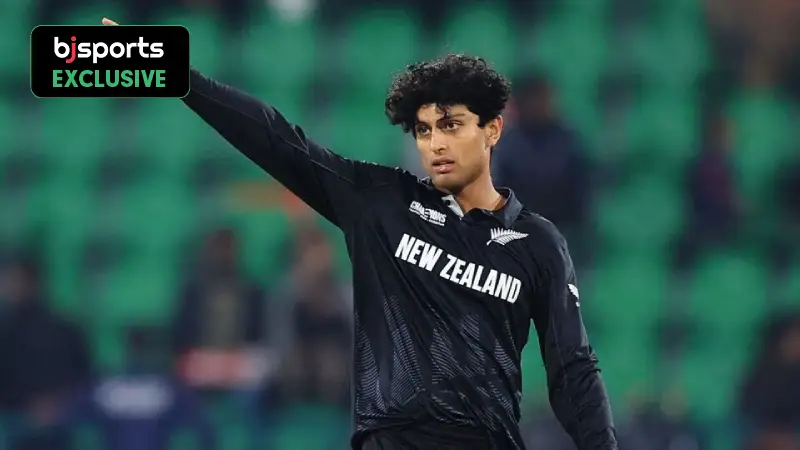
All-rounder Rachin Ravindra played an important role for New Zealand in the T20 World Cup with his contributions in both departments. Ravindra scored 129 runs in seven innings and also impressed with the ball, taking 12 wickets at an excellent average of 12.41. He maintained an economy rate of 7.84 and a strike rate of 13.00, proving to be a valuable all-round asset for the team. Ravindra had a quiet start to the tournament, scoring a duck while returning figures of 1/14 against Afghanistan. In the following match against the United Arab Emirates, he went wicketless with figures of 0/19. However, he contributed with both bat and ball against South Africa, scoring 13 runs and picking up 1/9.
His most impactful performance with the bat came against Canada, where he played a brilliant unbeaten knock of 59 to guide New Zealand to victory. Ravindra also delivered outstanding spells in the Super Eight stage, taking 4/27 against Sri Lanka and 3/19 against England. In the final against India, he managed to take 1/32.
Matt Henry

Matt Henry was another key performer for New Zealand with the ball. He is known for his disciplined line and length and maintained tight control over the opposition batters throughout the tournament. He began the competition with figures of 1/27 against Afghanistan and followed it up with 2/37 against the United Arab Emirates. Although he went wicketless against South Africa, he bounced back by taking 1/28 against Canada.
Henry produced one of his most economical spells against Sri Lanka, finishing with impressive figures of 2/3. He continued his steady run with 1/19 against England and played an important role in the semi-final with figures of 2/34. In the final against India, Henry picked up 1/49. Overall, he finished the tournament with 10 wickets in eight innings at an average of 23.50, an economy rate of 8.24, and a strike rate of 17.10.
James Neesham

All-rounder James Neesham also contributed with the ball during the tournament. Neesham claimed six wickets in seven innings at an average of 30.16, with an economy rate of 10.64 and a strike rate of 17.00. He started the tournament with figures of 0/33 against Afghanistan and followed it up with 0/7 against the United Arab Emirates. Neesham picked up his first wicket of the campaign against South Africa, returning figures of 1/15, and later took 1/38 against Canada.
In the semi-final clash, he delivered a useful spell of 1/42. Neesham produced one of his best performances in the final against India, where he picked up 3/46, ending the tournament with a notable contribution for New Zealand.
Disclaimer: This Exclusive News is based on the author’s understanding, analysis, and instinct. As you review this information, consider the points mentioned and form your own conclusions.
 Top 3 wicket-takers from West Indies tour of India 2026
 Top 3 bowlers to watch out for in Match 2 of Tri-Series between Zimbabwe and Afghanistan
 Top 3 batters to watch out for in Match 2 of Tri-Series between Zimbabwe and Afghanistan
 Top 3 player battles to watch out for in Match 2 of Tri-Series between Zimbabwe and Afghanistan