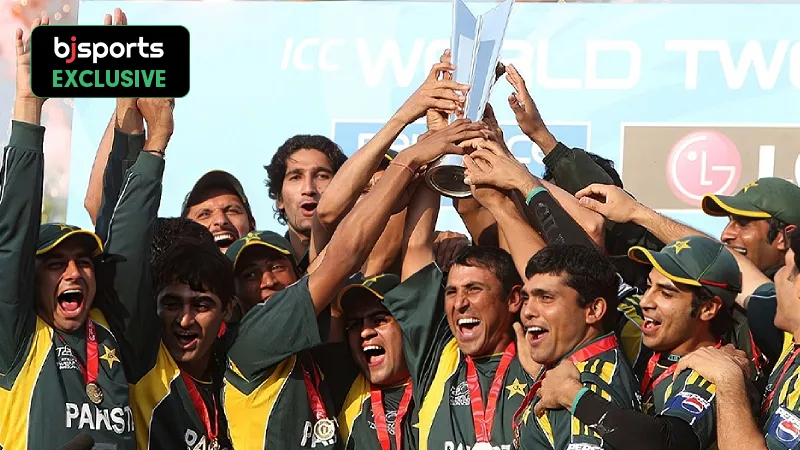
On this day, June 21, 2009, Pakistan won the ICC World Twenty20 by defeating Sri Lanka by eight wickets in the final at Lord’s. It was Pakistan’s first global title since the 1992 Cricket World Cup and a significant achievement for a side that had experienced considerable inconsistency in the years leading up to the tournament. Having finished runners-up to India in the inaugural World Twenty20 in 2007, Pakistan returned two years later with a more settled combination and produced a series of disciplined performances to claim the championship.
Sri Lanka batted first after winning the toss and found scoring difficult against Pakistan’s varied bowling attack. The innings never gained sustained momentum as wickets fell at regular intervals. Openers Tillakaratne Dilshan and Sanath Jayasuriya, both influential throughout the tournament, were unable to make substantial contributions in the final. Pakistan’s bowlers maintained tight lines and lengths, preventing Sri Lanka from accelerating during the powerplay and middle overs. Abdul Razzaq delivered one of the most important spells of the match, dismissing Jayasuriya and Mahela Jayawardene while conceding very few runs. His control created pressure that Sri Lanka struggled to overcome.
Kumar Sangakkara played the defining innings of Sri Lanka’s total. Batting with composure amid regular setbacks, he remained unbeaten on 64 from 52 balls and ensured his side posted a competitive score. His innings contained six boundaries and reflected a careful balance between risk and responsibility. However, the lack of substantial support from the other end limited Sri Lanka’s progress. Pakistan’s bowlers shared the workload effectively, with Mohammad Amir, Saeed Ajmal, Shahid Afridi and Razzaq all contributing important overs. At the end of 20 overs, Sri Lanka had reached 138 for 6, a total that offered a chance but left little margin for error.
Pakistan approached the chase with confidence and clarity. Openers Kamran Akmal and Shahzaib Hasan provided a positive start, putting pressure back on the Sri Lankan attack. Akmal scored 37 and ensured the required rate remained under control. Although Pakistan lost two wickets, they never appeared to be falling behind the target. The innings was then shaped by a crucial partnership between Shahid Afridi and Shoaib Malik. Their measured approach prevented Sri Lanka from creating sustained pressure and gradually moved Pakistan towards victory.
Afridi produced one of the finest innings of his T20 international career. Promoted into a central batting role during the tournament, he combined restraint with attacking strokeplay to remain unbeaten on 54 from 40 balls. His innings included two fours and two sixes and demonstrated a level of maturity that had become increasingly evident throughout the competition. Malik provided valuable support with an unbeaten 24, allowing Afridi to guide the chase. Pakistan reached 139 for 2 in 18.4 overs, securing victory with eight wickets in hand and eight balls remaining.
Afridi’s all-round contribution throughout the tournament made him one of its standout performers, and he was named Player of the Match in the final. Pakistan’s success was built on an outstanding bowling unit featuring Amir, Ajmal, Umar Gul and Razzaq, supported by an adaptable batting order capable of responding to different situations. The victory at Lord’s remains one of the most important achievements in Pakistan’s cricket history. It ended a 17-year wait for a major ICC title and confirmed Pakistan’s status as one of the leading teams in the shortest format of the game.
Disclaimer: This Exclusive News is based on the author’s understanding, analysis, and instinct. As you review this information, consider the points mentioned and form your own conclusions.
 3 West Indies Batters Who Could Be a Threat to India in 4th T20I
 3 West Indies bowlers that could threaten India’s batters in 3rd T20I
 3 West Indies batters that could threaten India’s bowlers in 3rd T20I
 3 Indian bowlers to watch out for in 3rd T20I