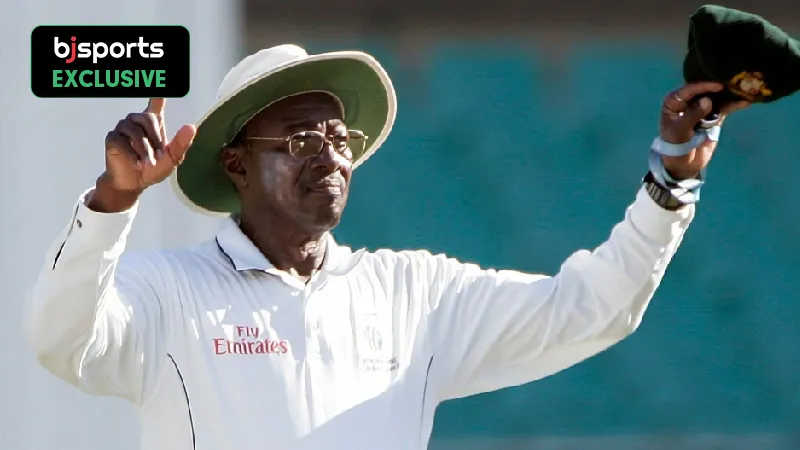
On May 31, 1946, in Montego Bay, Jamaica, cricket gained one of its most recognisable figures. Steve Bucknor never scored a Test hundred, never bowled a decisive spell and never captained a side. Yet for two decades, his presence became as familiar to international cricket as the players themselves.
For an entire generation, Bucknor was the face of umpiring.
Tall, composed and instantly recognisable with his measured movements, Bucknor stood in a record 128 Test matches between 1989 and 2009, a mark that defined longevity at the highest level. Long before neutral umpires became routine and before technology transformed decision-making, he was trusted with cricket’s biggest occasions. Few officials have occupied the centre of the game’s stage for as long.
His journey into umpiring was hardly conventional.
Before cricket claimed him, Bucknor was a mathematics teacher and an accomplished football referee. He even officiated in FIFA World Cup qualifying matches, making him one of the rare sporting figures to operate at elite international levels across two different sports. The discipline of a classroom teacher and the authority of a football official became hallmarks of his cricketing personality.
When he made his international umpiring debut during India’s tour of the Caribbean in 1989, nobody could have predicted the scale of the career that lay ahead. Over the next twenty years, Bucknor became one of the most trusted figures in world cricket.
The numbers remain staggering.
He officiated in 128 Tests and 181 One-Day Internationals. He stood in five consecutive Cricket World Cup finals from 1992 to 2007, an achievement unmatched by any umpire before or since. In an era when international cricket was expanding rapidly, Bucknor became one of its constants. Players changed, teams evolved and generations came and went, but Bucknor remained.
His style was unmistakable.
There was nothing rushed about Steve Bucknor. Every appeal seemed to be followed by a pause that felt eternal. Batsmen waited nervously. Crowds held their breath. Then came the famous raised finger, often accompanied by a slight nod. The delay earned him the nickname “Slow Death”, a title that followed him across cricketing continents.
Like every long-serving umpire, Bucknor’s career was not free from controversy. His later years were scrutinised heavily, particularly in an era when television replays exposed every error in microscopic detail. Some decisions involving Sachin Tendulkar and the infamous Sydney Test of 2008 became permanent subjects of debate among cricket followers.
Yet reducing Bucknor’s legacy to a handful of disputed calls ignores the scale of his contribution.
For most of his career, he was considered among the game’s elite officials. Administrators trusted him with World Cup finals. Captains respected his authority. Fellow umpires looked to him as a standard-bearer for professionalism during a period when international officiating was becoming increasingly demanding.
Perhaps that is the truest measure of his impact. Great umpires are rarely remembered for the thousands of correct decisions they make. They are remembered for the few they miss. Bucknor lived with that reality longer than almost anyone.
Disclaimer: This Exclusive News is based on the author’s understanding, analysis, and instinct. As you review this information, consider the points mentioned and form your own conclusions.
 IPL 2026: Key Tactical Matchups to Watch – RCB vs GT, Final
 IPL 2026 Final: Predicted Playing XI for GT vs RCB
 OTD | Viv Richards Played The Greatest ODI Innings Of All Time
 Which 3 Batters Could Fire Together and Win the GT vs RCB IPL 2026 Final?