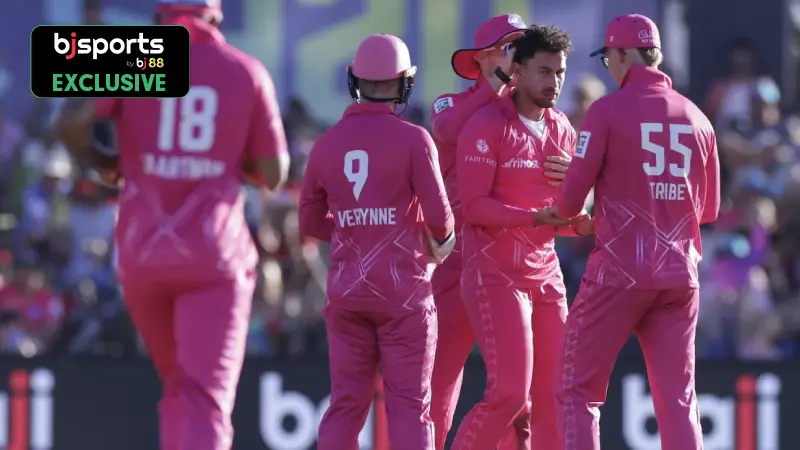
Boland Park is one of those venues where you will find out who the fakes are. The slow surface and low bounce there do not reward raw pace, nor do they reward raw power hitting; Boland Park demands to know how good your patience is, how good your ability to hit from different angles is, and how well you can adjust to the conditions you find yourself playing under. Hosting MI Cape Town in the 10th Match of SA20 2025–26 in Paarl could feel like a very comfortable home game for the Paarl Royals.
Youthful Openers, Immediate Pressure
Selecting Lhuan-dre Pretorius and the Asa Tribe as openers can be seen as an impulsive move for Paarl Rocks. Although both are naturally aggressive, the slower bounce at Boland Park does little to reward this type of aggression in the opening over, forcing batsmen to generate their own run rate (pace) rather than borrowing it from the bowler. This could allow Pretorius’ square of the bat and Tribe’s clean down-swing to create opportunities; however, the temptation to win the game in 6 overs may have to be avoided.
Middle Order Built for Damage Control
Kyle Verreynne and Rubin Hermann are the two players who will provide stability to the batting line-up. Both are expected to be steady rather than spectacular and have experience playing on slow surfaces with minimal boundary opportunities. In particular, Verreynne has had success on similar Cape Town pitches for many years and can help keep the scoreboard ticking over when no big hits are being scored.
David Miller’s inclusion at number five represents a combination of tradition and measured risk-taking by Miller as the team captain. The risk is that Miller may be tempted to play the way he is known to and hit cross-bat late in the innings to try to post a large score. Boland Park has historically penalized such tactics, and therefore, his role here is more likely to be to stabilize the innings and then try to accelerate the scoring rate.
Lower Middle Order or Tactical Insurance?
Potgieter brings power to slow pitches, and Lion-Cachet adds batting skill and adaptability in spinning conditions. Neither player is likely to provide a lot of explosive cricket, but they will be able to help protect the tail.
This is a practical option and perhaps even an admission that the nature of this pitch makes depth preferable to showmanship.
Spin as Strategy, Not Support
Rather than being complementary to each other in this role, Mujeeb Ur Rahman and Bjorn Fortuin represent the tactical backbone. They can dominate the middle overs with their respective variations and slight variations in pace, as the surface will offer some grip and skid. They will also allow Paarl to go after them with little risk of taking wickets in bulk.
Ottneil Baartman and Nqobani Mokoena make up the rest of an attack based around control, rather than pace. While neither has much expressiveness, both have a good understanding of how to get seam movement off the slower surfaces. These are bowlers for Paarl, not bowlers against the pitches.
Key Takeaway
Paarl Royals aren’t picking stars, they’re picking answers to the pitch.
FAQs
What makes Boland Park different from other SA20 venues?
It’s a slower surface and lower bounce reward control, not raw pace or power.
Why is spin so important in this XI?
The pitch grips, making variations and accuracy more effective than speed.
How can Paarl Royals beat MI Cape Town here?
By batting deep, rotating strike, and letting their spinners dictate tempo.
Disclaimer: This Exclusive News is based on the author’s understanding, analysis, and instinct. As you review this information, consider the points mentioned and form your own conclusions.
 Top 3 Bowlers to Watch Out for in Test Series Between Bangladesh and the West Indies
 Predicted Playing XI of Bangladesh for First Test Against West Indies
 Predicted Playing XI of Sri Lanka in 5th Match of Tri-Series Against Pakistan
 Predicted Playing XI of Pakistan in 5th Match of Tri-Series Against Sri Lanka